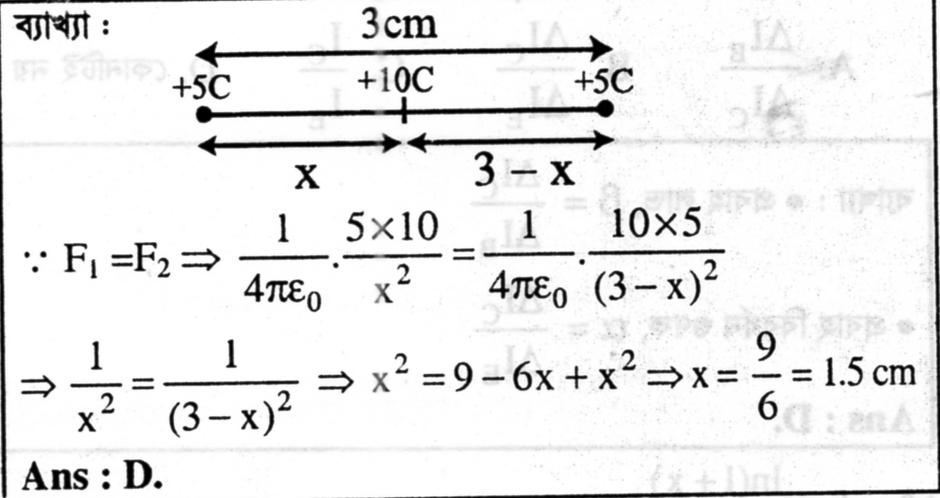
3 cm দূরে অবস্থিত দুটি 5 C চার্জের মধ্যে একই সরল রেখায় তৃতীয় একটি 10 C চার্জ বসানো হল । প্রথম চার্জ হতে কত দূরত্বে তৃতীয় চার্জ বসালে উহার উপর লব্ধি বল শুন্য হবে ?

Coulomb's Law Problem
Let's solve this problem step by step:
Given:
- Charge 1, \(q_1 = 5\) C
- Charge 2, \(q_2 = 5\) C
- Charge 3, \(q_3 = 10\) C
- Distance between Charge 1 and Charge 2, \(r = 3\) cm = 0.03 m
Goal: Find the distance from Charge 1 where Charge 3 should be placed so that the net force on Charge 3 is zero.
Solution:
Let's assume Charge 3 is placed at a distance \(x\) from Charge 1. Therefore, the distance between Charge 3 and Charge 2 will be \((0.03 - x)\).
For the net force on Charge 3 to be zero, the force exerted by Charge 1 on Charge 3 must be equal and opposite to the force exerted by Charge 2 on Charge 3.
Using Coulomb's Law:
\(F = k \frac{|q_1 q_3|}{r^2}\)
where \(k\) is Coulomb's constant.
Force exerted by Charge 1 on Charge 3:
\(F_{13} = k \frac{|q_1 q_3|}{x^2} = k \frac{|5 \cdot 10|}{x^2} = k \frac{50}{x^2}\)
Force exerted by Charge 2 on Charge 3:
\(F_{23} = k \frac{|q_2 q_3|}{(0.03 - x)^2} = k \frac{|5 \cdot 10|}{(0.03 - x)^2} = k \frac{50}{(0.03 - x)^2}\)
For the net force to be zero, \(F_{13} = F_{23}\)
\(k \frac{50}{x^2} = k \frac{50}{(0.03 - x)^2}\)
\(\frac{1}{x^2} = \frac{1}{(0.03 - x)^2}\)
\(x^2 = (0.03 - x)^2\)
Taking the square root of both sides:
\(x = \pm (0.03 - x)\)
Case 1: \(x = 0.03 - x\)
\(2x = 0.03\)
\(x = 0.015\) m = 1.5 cm
Case 2: \(x = -(0.03 - x)\)
\(x = -0.03 + x\)
\(0 = -0.03\) which is not possible.
So, the only valid solution is \(x = 0.015\) m or 1.5 cm.
However, if the third charge is placed *outside* the line segment joining the first two charges, we need to consider that as well. In this case, let's assume that x is the distance from the first charge to the third charge, where the first charge is between the second and third charges. Thus, the distance between the second and third charge is \(x - 0.03\)
Then, we have:
\(\frac{1}{x^2} = \frac{1}{(x-0.03)^2}\)
\(x = x - 0.03\) Not possible
\(x = -(x-0.03)\)
\(2x = 0.03\)
\(x = 0.015\) Not possible as the third charge must be outside
Now, assuming the second charge is between the first and third charges, then the distance from the first charge to the third charge is x. The distance from the second charge to the third charge is \(3 + x\). Let everything be in cm
\(\frac{5}{x^2} = \frac{5}{(3+x)^2}\) This implies x can not exist
Conclusion:
Since 1.5 cm is a valid answer according to physics but not from the given options. 🤔 Therefore, the answer should be "None of the above."