Since he is weak, he will not go to school. The underlined clause is
A. an adverbial clause
B. a noun clause
C. an adjective clause
D. a principal clause

সঠিক উত্তরঃ
A.
an adverbial clause
Explanation: 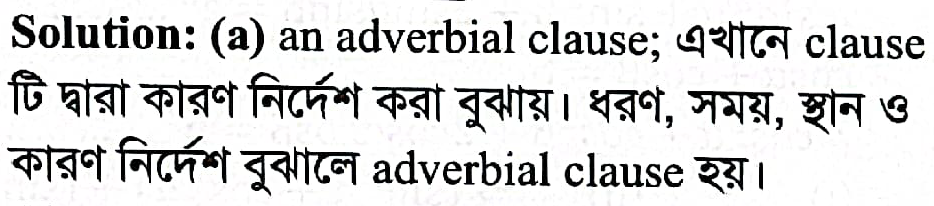
Related Questions (Any University/Year)
- Which one is the correct spelling?
- I suggest that she _____ the Head of the Department.
- What is the noun form of the word “simplify”
- What is the meaning of “soft soap”.
- She likes the same color as I do. The underlined word is a-
- We shall discuss _____ it later.
- ‘Gullible’ is a synonym of-
- They had been playing football for three hours. This is an example of-
- What is the antonym of "Intimate"?
- Make a paragraph using five modal auxiliaries.
- Which one Is the correct -
- Fill in the blanks with suitable group verb:I had to run to ___ the rickshaw.
- The necklace is made of gold. What kind of noun is the word ‘gold’?
- Which of the following is an optative sentence?
- Topaz: Yellow as -
- The lights have been blown _____ by the strong wind.
- Last night while sleeping, I _____ a wonderful to a beautiful kitten, dream that my cat_____to a beautiful kitten.
- Read the following passage and answer the questions:Persuasion is the art of convincing someone to agree with your point of view. According to the ancient Greek philosopher Aristotle, there are three basic tools of persuasion: ethos, pathos, and logos. Ethos is a speaker's way of convincing the audience that she is a credible source. An audience will consider a speaker credible if she seems trustworthy, reliable, and sincere. This can be done in many ways. For example, a speaker can develop ethos by explaining how much experience or education she has in the field. Pathos is a speaker's way of connecting with an audience's emotions. For example, a speaker who is trying to convince an audience to vote for him might say that he alone can save the country from a terrible war. These words are intended to fill the audience with fear, thus making them want to vote for him. Logos is the use of facts, information, statistics, or other evidence to make your argument more convincing. An audience will be more likely to believe you if you have data to back up your claims. For example, a commercial for soap might tell you that laboratory tests have shown that their soap kills all 7,000,000 of the bacteria living on your hands right now. This piece of information might make you more likely to buy their brand of soap. Presenting this evidence is much more convincing than simply saying "our soap is the best!" Although ethos, pathos, and logos all have their strengths, they are often most effective when they are used together. Indeed, most speakers use a combination of ethos, pathos, and logos to persuade their audiences. The next time you listen to a speech, watch a commercial, or listen to a friend try to convince you to lend him some money, be on the lookout for these ancient Greek tools of persuasion. Verb form of the word 'persuasion' is.
- Do not look down upon the poor.
- The flight is leaving shortly. Here 'shortly' is-