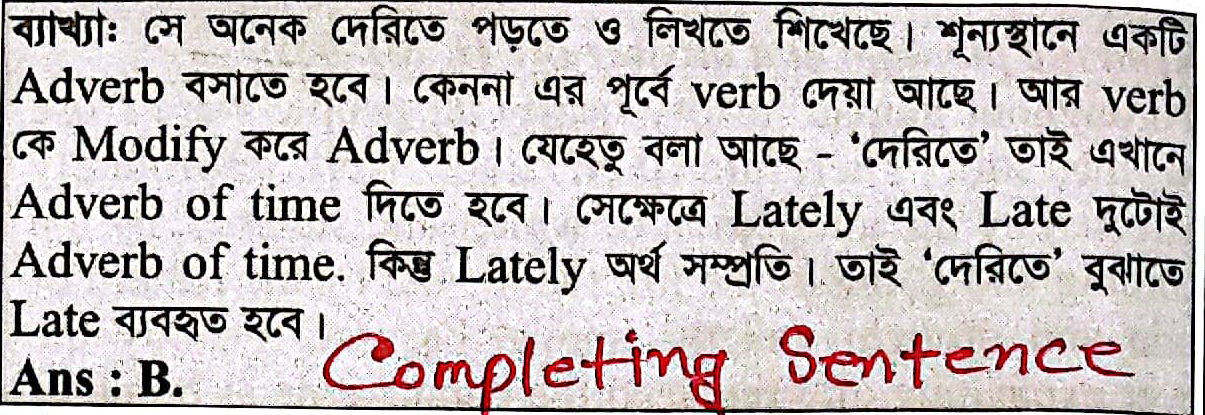
He learned to read and write quite ____ in his life.
A. lately
B. late
C. latest
D. taste

সঠিক উত্তরঃ
B.
late
Explanation:
Related Questions (Any University/Year)
- He ____ dress formally to work but he always ____ .
- The situation was bad, but it _____ worse.
- In today's globalised world, Indigenous culture _____ by foreign culture.
- The dog was_____ in front of the door.
- Forensic experts have__ samples from the spot to __ whether there are any traces of explosives
- Choose the "Correct form of the verb" in parenthesis of the following sentence:'Ali would rather............ (sleep) than worked last night."
- What is the right form of verb in the bracket of following sentence? - The match is (telecast) now.
- We went to Chittagong last month to see the house where we ___ in the 1960s.
- Fill the blank with the right option : I am looking forward _you.
- What________your father______?
- Would you mind ____ me a cup of tea?
- Choose the correct verb to complete the sentence. You had better _____ a doctor.
- He made his children _____ their homework every afternoon.
- I lay for sometime ......... the clouds in the sky.
- Fill in the blank, "The small child does whatever his father _______."
- I must have him ___ my proposal.
- He arrested if he had tried to leave the county?
- Which one is the correct form of the verb 'hear' in the blank space of the space of the sentence? 'I opened the door as soon as I ___ the bell.'
- Do you enjoy _____cricket matches on TV ?
- She __________ her finger by interfering in neighbour's affair.
- He ______ home last Monday.
- The novel thay you________$$ is known to me.
- Read the text and fill in the gaps with the correct form of verbs and subject-verb agreement as per context.Would you mind (a) _____ (receive) my letter. I am extremely sorry for (b) _____ (be) latE- Had I had any message about your illness, I (c) _____ (visit) you. Believe me, since my return from Australia, I have got myself (d) _____ (engage) in raising awareness among people (e) _____ (send) their daughters to school. In this country, girls (f) _____ (deprive) of proper education and guidancE- Due to lack of education, they (g) _____ (not know) what they (h) _____ (need). For years, they (i) _____ (neglect) in society.
- The traffic lights ------ green and I pulled away.
- Choose the proper option to fill in the blank in the sentence ,"If it rains , we ____ ludo ."
- Read the text and fill in the gaps with the correct form of verbs as per subject and context.It is natural that a man cannot (a) _____ (live) alonE- He always (b) _____ (need) a company. He has to (c) _____ (express) his thought and ideas, (d) _____ (think) others while the others (e) _____ (be) of the same needs. He (f) _____ (have) also the need of others for (g) _____ (ensure) their safety and comfort. So, he is bound (h) _____ (live) with others (i) _____ (make) an institution and it (j) _____ (call) society. Society (k) _____ (be) the first organization which (l) _____ (make) by our primitive ancestors. They (m) _____ (be) the first to contribute to (n) _____ (develop) the civilization.
- Read the text and fill in the gaps with the correct form of verbs as per subject and context.In a dark night of March 1971, Pakistani Army (a) ----(attack) the innocent Bangladeshis. They did it with a view to (b) ---- (stop) our movement for democracy. But our brave people protest against them (c) ---- (save) the honour of our motherland. Many of our freedom fighters (d) ---- (kill) and injured but they (e)---- (not, give) up fighting. The 7th March speech of Bangabandhu also (f) ----- (prove) very significant then. It was a public speech (g) ----(deliver) by the Founder Father of Bangladesh at the Ramna Race Course in Dhaka to a gathering of over two million people. At last, after a blood shedding war of 9 months, we managed (h) ---- (achieve) independence on 16 December 1971. Therefore, this day (i) --- (observe) as the Victory day with great enthusiasm. The Martyred Intellectual Day (j)---- (observe) every year on December 14. On this day the brightest minds of the nation (k) ---- (massacre) by the Pakistan Army. Independence War (l) --- (consider) as the greatest incident in our national life. If we did not get independence, we (m) --- (exploit) by the Pakistani rulers. So, it is high time we (n) ---- (ensure) the privileges of independence in all spheres of life.
- The writer was too young-to say 'no' to a women. Choose the right option for the gap
- The lady sat______her cat.
- No man can ____ alone.
- The book ___ is not in the library.
- She ____ not eat it.
- The ship with all its crew ___ lost after the terrible storm.
- Fill in the blank. By the middle of the 21st century, the computer____ necessary in every home.
- But for your help, I would.........in my attempt.
- Write a paragraph comparing and contrasting junk food and healthy food. Use 200 words
- I the 9th letter of English alphabet.
- Choose the appropriate verb form : We talked for a long time after we ........... home.
- He did not write to me, nor___
- We_ the car to Sylhet next month because the journey takes too long.