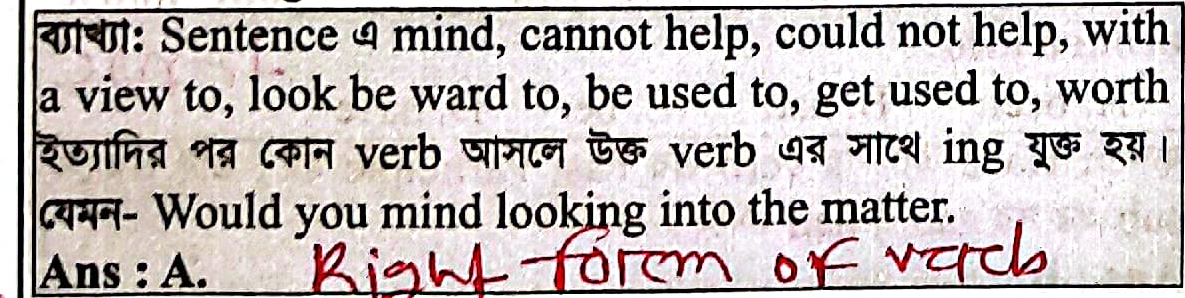
Would you mind —— ?
A. looking into the matter
B. to look into the matter
C. looking at the matter
D. looking for the matter

সঠিক উত্তরঃ
A.
looking into the matter
Explanation:
Related Questions (Any University/Year)
- Pick up the right form of verb (to be) to fill up the blank in the sentence "He talks as if he-mad".
- I...... take a taxi than walk home.
- It's been raining all morning and I'm sure it'll go ____ all afternoon as well.
- Rony said that he____her dancing.
- He made me _______ the car.
- The doctor suggested that the patient______weight.
- The rich ________ of fresh coffee.
- Our team won the football mathch, but_____ players played well ; in fact thay ____ played quite badly .
- In a debate ,it is sometimes necessary to remind speakers about the main points which are considered .
- The fat man is trying hard to ________ weight.
- You had better ____ him at once.
- We went to Chittagong last month to see the house where we ___ in the 1960s.
- It is high time we _____ our attitude.
- Which one Is correct?
- Complete the sentence using suitable clasue/phrase : My father will come tonight from New York. I ______go to the airport.
- It is raining. You need not ___ today.
- I painted my house with a view to___it
- Read the passage and then write the antonym or synonym of the words as directed below.The Negro is still not free. The life of the Negro is still sadly crippled by the manacles of segregation and the chains of discrimination. The Negro lives on a lonely island of poverty in the midst of a vast ocean of material prosperity. The Negro is still languishing in the corners of American society and finds himself an exile in his own land. So, we have come here today to dramatize a shameful condition. I say to you today, my friends, even though we face the difficulties of today and tomorrow, I still have a dream. It is a dream deeply rooted in the American dream. I have a dream that one day this nation will rise up and live out the true meaning of its creed: "We hold this truth to be self-evident that all men are created equal."(a) free (antonym); (b) crippled (synonym); (c) manacles (synonym); (d) discrimination (synonym); (e) lonely (synonym); (f) vast (antonym); (g) prosperity (antonym); (h) shameful (synonym); (i) face (synonym); (j) difficulty (antonym); (k) nation (synonym); (l) rise (antonym); (m) created (antonym); (n) equal (antonym)
- The situation was bad, but it _____ worse.
- I fancy I (turn) a trifle pale.
- He must avoid ______ until his knee heals.
- I found it difficult to convince the ticket inspector that I ___ my ticket .
- I ___ Raju to call a painter to ___ the house painted. Appropriate fillers for the blanks are-
- Choose the right form of verb :Studying lots of books (make) a person knowledgeable and wise.
- Choose the correct sentence :
- Find the correct form of verb: He worked instead of- --
- Write a paragraph comparing and contrasting junk food and healthy food. Use 200 words
- The resort is ____ a big influx of foreign tourists this year.
- Read the text and fill in the gaps with the correct form of verbs and subject-verb agreement as per context.Road mishap (a) _____ (happen) in our country almost everyday. Recently, it (b) _____ (rise) to an alarming rate (c) _____ (take) a heavy toll of human lives. The members of a family remain anxious if someone (d) _____ (travel) in a bus. In most cases, reckless driving (e) _____ (cause) road accidents. The drivers are in the habit of (f) _____ (violate) traffic rules. Road accidents can (g) _____ (reduce) if the drivers drive their vehicles carefully. People should be conscious in this respect. While (h) _____ (cross) the road, they should be careful. Some people travel (i) _____ (climb) on the roof of the buses and trains. Traffic rules (j) _____ (maintain) strictly with a view to controlling road accidents.
- The world was _____ to the happenings in Syria, Ameraca's political class was _____ by the attacks.
- A new house ---- at the corner of the road .
- Read the text and fill in the gaps with the correct form of verbs as per subject and context.When I was a child I (a) _____ (be) afraid of the dark, and I (b) _____ (go) to sleep with a light on. Even then, I feared that monsters (c) _____ (climb) in through my bedroom window. Every sound I (d) _____ (hear) struck fear into mE- Often, I ran away from the room and (e) _____ (sleep) on the floor at the foot of my parents' bed. Now that I (f) _____ (be) almost twenty, I obviously do better than what I (g) _____ (do) as a child. However, I (h) _____ (be) still scared of bedtimE- I hate (i) _____ (sleep) alone, and I still keep a tiny night-light on. And before I go to bed, I double check every door and every window to make sure that they (j) _____ (be) locked.
- While the man --- in the field, suddenly a dog came and --- him.
- Find out the correct sentence ------.
- Find out sentence with the correct from of verb of the following sentence : Had I been a king , I (help) the poor.
- I would never ———— the use of capital punishment, no matter how serious the crime.
- Read the text and fill in the gaps with the correct form of verbs as per subject and context.Newspaper (a) _____ (consider) the people's parliament. The newspaper (b) _____(play) a vital role in modern civilization. It (c) _____ (call) to be the mirror of the world. We must (d) _____ (develop) the habit of (e) _____(read) the newspaper daily. It helps us (f) _____(acquire) general knowledge, which (g) _____ (be) essential for our education. Nobody (h) _____ (maintain) contact with the outside world without reading the newspaper. Mere bookish knowledge (i) _____ (be) not sufficient in the struggle of lifE- A man who (j) _____ (read) the newspaper daily (k) _____ (be) like a creature of the narrow well. Being ignorant of current topics, he cannot (l) _____ (take) part in the talks and discussions in an enlightened society and he (m) _____ (live) like a fish out of water in it. Students (n) _____ (ask) for reading newspaper daily.
- What________your father______?
- Mandela ___ to life imprisonment in 1964.
- Fill up the blank space in the sentence "Students should the advice of their superiors”, by correct words from the followings.