Which of the following words means the opposite of 'Obscure'?
A. Dubious
B. Lucid
C. Vague
D. Indistinct

সঠিক উত্তরঃ
B.
Lucid
Explanation: 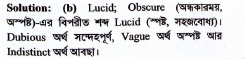
Related Questions (Any University/Year)
- You have to leave the shoes _____ the door when you enter the home.
- Which is the synonym of the word 'Resolute'?
- Make a paragraph using the following words: harbinger, hasten, halt, hostile, greedy
- Choose the correct sentence.
- 'Dog Days' means-
- Identify the gerund in the following sentence: "She enjoys 'swimming' in the ocean."
- Which sentence correctly uses the causative verb “get” to express a situation where someone is arranging for someone else to do something?
- "To win a prize is my ambition." The underlined part is a/an ____
- The correct passive form of-He is going to open a shop.
- Which one is the singular?
- I am fed up ______ waiting for her to telephone.
- The crowd was very big. Which form of noun is the underlined word?
- Which of the following word is in singular form?
- Which of the following sentence is correct-
- Change the voice:What did they pay you for doing the job?
- Choose the option where the suffix or prefix has been incorrectly used.
- Read the following passage and answer the questions:Persuasion is the art of convincing someone to agree with your point of view. According to the ancient Greek philosopher Aristotle, there are three basic tools of persuasion: ethos, pathos, and logos. Ethos is a speaker's way of convincing the audience that she is a credible source. An audience will consider a speaker credible if she seems trustworthy, reliable, and sincere. This can be done in many ways. For example, a speaker can develop ethos by explaining how much experience or education she has in the field. Pathos is a speaker's way of connecting with an audience's emotions. For example, a speaker who is trying to convince an audience to vote for him might say that he alone can save the country from a terrible war. These words are intended to fill the audience with fear, thus making them want to vote for him. Logos is the use of facts, information, statistics, or other evidence to make your argument more convincing. An audience will be more likely to believe you if you have data to back up your claims. For example, a commercial for soap might tell you that laboratory tests have shown that their soap kills all 7,000,000 of the bacteria living on your hands right now. This piece of information might make you more likely to buy their brand of soap. Presenting this evidence is much more convincing than simply saying "our soap is the best!" Although ethos, pathos, and logos all have their strengths, they are often most effective when they are used together. Indeed, most speakers use a combination of ethos, pathos, and logos to persuade their audiences. The next time you listen to a speech, watch a commercial, or listen to a friend try to convince you to lend him some money, be on the lookout for these ancient Greek tools of persuasion.The opposite meaning of the word 'credible' is.
- Fill in the blanks with suitable group verb:I had to run to ___ the rickshaw.
- They should take _____ cycling
- I am very proud _____ you.