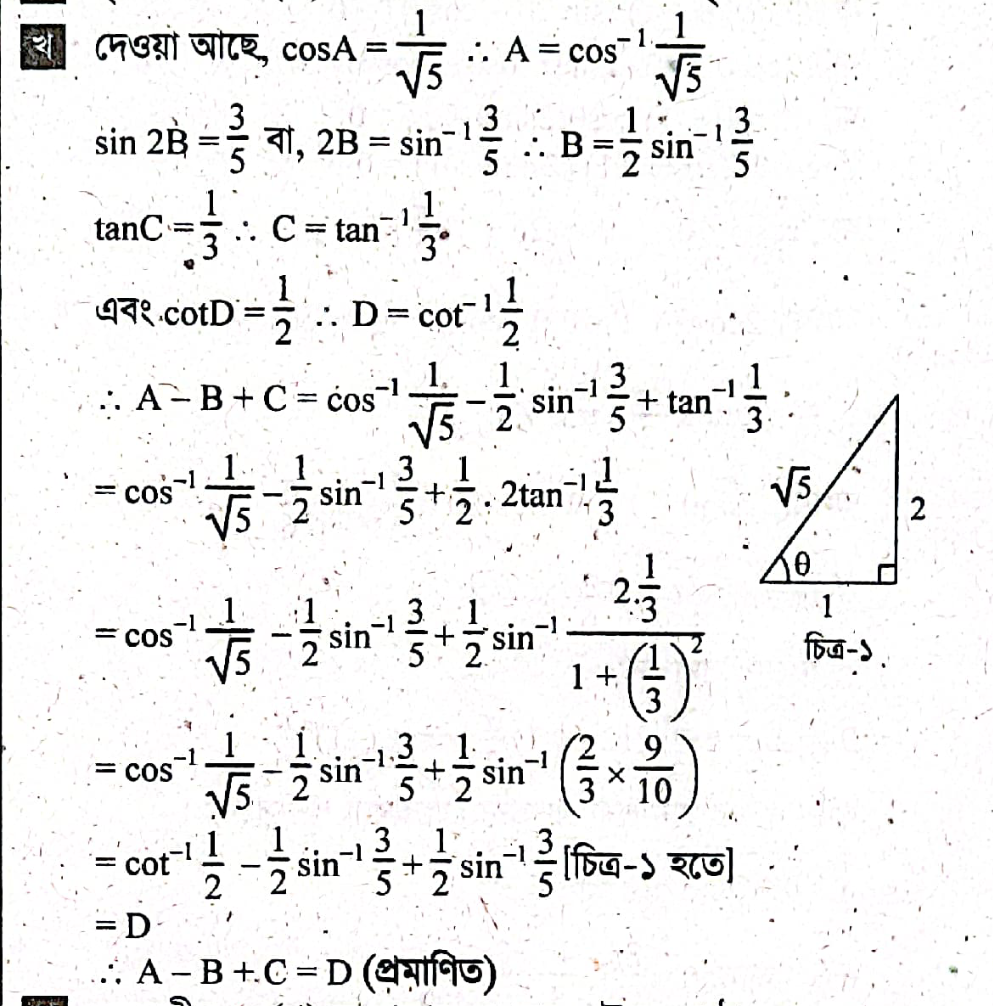
f(A) = cosA = 1/(5) sin2B = 3/5 tanC= 1/3 cotD= 1/2
প্রমাণ কর যে, A-B+C=D
A.
B.
C.
D.
উচ্চতর গণিত দ্বিতীয় পত্রবিপরীত ত্রিকোণমিতিক ফাংশন ও ত্রিকোনমিতিক সমীকরনত্রিকোণোমিতিক ফাংশনের সাধারণ সমাধান (Topic Practice)

Explanation:
Related Questions (Any University/Year)
- f(x)=tanxসমাধান কর: int(π/2-2x)=cosx+sinx. x2 +y2 =1
- i)sin(πcos θ) =cos( πsin θ) ii)x=cosA,y=cosB, z=cosC i) হতে দেখাও যে, θ = ± π/4+(tan-1√7)
- 1/2 (cotθ – tanθ) = 1 হলে,θ =?
- f(x)= sqrt3cosec2x-sec2x, g(x)=cosx sqrt3g(π/2-x) -g(x)=2 সমীকরণটির সমাধান কর। যখন -2π<x<2π
- cot2x cotx=1 হলে x =?
- sinx cos x = 1/4 হলে x এর মান কত ?
- sin(x/2)+cos(x/2)=0 হলে, x =?,
- cosec θ+ cot θ=√3, then what's the value of θ?
- sinθ= 1/√2 এর সাধারন সমাধান কোনটি ?
- sinθ - cos2θ = 2 এর সাধারণ সমাধান কোনটি?
- দৃশ্যকল্প-১: 2 sin2θ-2 = cos 2θ; দৃশ্যকল্প-২: f(y) = tan-1y.দৃশ্যকল্প-২ হতে প্রমাণ কর যে, tan {2f(x)} = 2 tan{f(x)+f(x3)}. x2 +y2 =1
- 2costheta=1 সমীকরণের সাধারণ সমাধান-
- n একটি পূর্ণসংখ্যা হলে sin{nπ + (-1)nπ/3} এর মান কত?
- sin (π/2cos alpha)=cos(π/2sinalpha) হলে ɑএর মান কত?
- 2/sqrt(2-sqrt(2+2cos4x))=?
- tan-1(4/3) + tan-1(1/2) =?
- cos−1{cos(−π/3)} = কত?
- f(x) = sin (π/2 -x)f(πsinθ) = sin {πf(θ)} হলে দেখাও যে, theta=± 1/2sin^-1 (3/4)