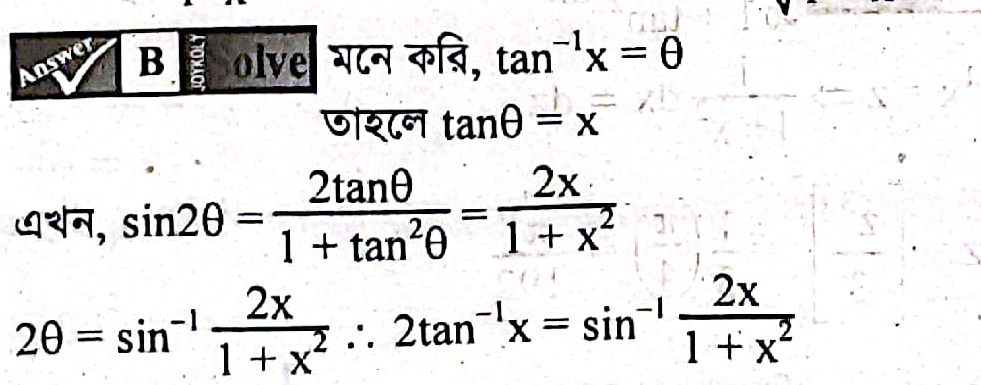
2 tan-1x=?
A. tan-1(2x/1+x2)
B. sin-1(2x/1+x2)
C. cos-1((1-x2/1+x2))
D. sec-1((x/√(1-x2))
CoUUnit-Cউচ্চতর গণিত দ্বিতীয় পত্রবিপরীত ত্রিকোণমিতিক ফাংশন ও ত্রিকোনমিতিক সমীকরনবিপরীত বৃত্তীয় ফাংশনের সূত্রাবলী (Topic Practice)CoU - ⚡ অনলাইন প্রশ্নব্যাংক দেখুন 💥

সঠিক উত্তরঃ
B.
sin-1(2x/1+x2)
Explanation:
Related Questions (Any University/Year)
- cos-1 x + cos-1 y = π/2 হলে x2 + y2 = ?
- sin-11/x এর মান হবে-
- tan-1 2x + tan-13x =π/4 হলে, x =?
- প্রমাণ কর যে, 1/2 sin^-1 x=tan^-1((1-sqrt(1-x^2)/x))
- প্রমাণ কর যে sin^-1 2x/(1+x^2) = cos (1-x^2)/(1+x^2)
- যদি y=sin^-1x+ sin^-1(sqrt(1-x^2)) হয় তবে, dy/dx = কত?
- tan-1x + cot-1x = কত?
- sin-1x+sin-1y=π/2 হলে নিচের কোনটি সঠিক?
- 2 cos-1 x =?
- f(x)=tan-1x হলে-f(1)=π/4 f(1/2)+f(1/3)=π/4 f(2x)=cos^-1 ((1-x^2)/(1+x^2))নিচের কোনটি সঠিক?
- যদি sin-1x +sin-1y =π/2 হয়, তাহলে (x2+y2) এর মান হচ্ছে -
- sin^-1(sqrtx/(1+sqrtx)) এর মান হলো-
- Sin-1x + Sin-1y = π/2 হলে x2 + y2 এর মান কত?
- tan^-1(4/3)+tan^-1(1/2) =?
- tan^-1 (1/2)+tan^-1 (1/3) = ?
- দেখাও যে, cot-11/6 + cot-15/7 = 3π/4
- বিপরীত ত্রিকোণমিতির ফাংশনের ক্ষেত্রে-tan-1x + cot-1x = π/2 <যখন x ≥ 0sin-1x + cot-1x = π/2-1≤x≤1cosec-1x + cot-1x=π/2<x<1 নিচের কোনটি সঠিক?
- sin^-1(4/5)+cos^-1(2/sqrt5) সমান-
- tan^-1(1/3)+tan^-1(1/7)+tan^-1(1/13)+......+tan^-1(1/(1+n+n^2))+...=?
- sin^-1x+cosec^-1(1/(sqrt(1-x^2)))=?
- \( \tan^{-1}(\frac{x+1}{3}) + \tan^{-1}(\frac{x-1}{3}) = \tan^{-1} 2 \) হলে, \( x \) এর মান কত?
- tan^-1((yz)/(xr))+tan^-1((zx)/(yr))+tan^-1((xy)/(zr))=? [x²+y²+ z² = r²]
- নিচের কোন সম্পর্কটি সত্য নয়?
- cotcos^-1sintan^-1(3/4) এর মান কত?
- sin-1x + sin-1y = π/2 হলে, x√(1-y2) + y√(1-x2) এর মান কত?
- sin[3(sin-1x + cos-1x)]=a হলে, a এর মান কত?
- Sin^-1 a + sin^-1b = π/2প্রমাণ কর যে a4+ 2a2b2+b4= 1
- প্রমাণ কর যে, 2tan^-1 (1/5)+cot^-1 7+2tan^-1(1/8)=π/4
- tan-12 + tan-1 3 এর মান কত?
- Marks=2.5
- নিচের কোন সম্পর্কটি সত্য নয়?
- প্রমাণ কর যে, 2tan^-1(sqrt(a/b)tan(θ/2))=sin^-1((2sqrt(ab)sinθ)/(b+a+(b-a)cosθ))
- \( \sin^{-1}x+\cos^{-1}x \) এর মান কোনটি?
- sin(2sin^-1(sqrt3/2)=?
- 2tan-1(cosx) = tan-1(2cosecx) হলে x =? (n ∈ ℤ )
- tan^-1(1/2)+tan^-1(1/3) +?
- \( \tan^{-1} \left( \frac{1}{7} \right) + \tan^{-1} \left( \frac{1}{8} \right) + \tan^{-1} \left( \frac{1}{18} \right) = ? \)
- tan^-1 ""2/3 +cos^-1""2/(sqrt(13))=?
- tan^-1x + tan^-1((1-x)/(1+x))=?
- 1/2 sin^-1x =?