The altitude of a parallelepiped whose three coterminous edges are vectorsvecA =hati+hat j +hat k‚ vecB = 2hati +4hatj − hatk and vecC = hat1+hatJj+3hatk,with vecA and vecBas sides of the base of the parallelepiped is-

(2√38)/19
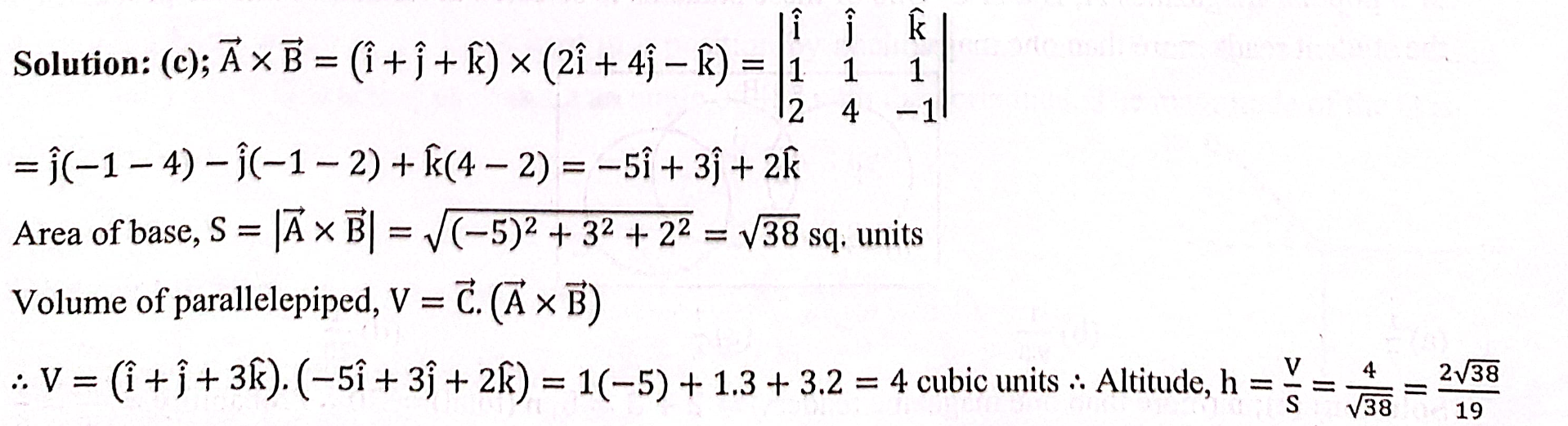
🤔 প্রশ্নটি একটি সমান্তরাল পেপেড (parallelepiped) এর উচ্চতা নির্ণয় করতে বলছে, যার তিনটি সন্নিহিত বাহু \( \vec{A} \), \( \vec{B} \) এবং \( \vec{C} \) ভেক্টর দ্বারা নির্দেশিত। যেখানে \( \vec{A} \) এবং \( \vec{B} \) ভূমি তৈরি করেছে।
📝 দেওয়া আছে:
\( \vec{A} = \hat{i} + \hat{j} + \hat{k} \)
\( \vec{B} = 2\hat{i} + 4\hat{j} - \hat{k} \)
\( \vec{C} = \hat{i} + \hat{j} + 3\hat{k} \)
📐 আমরা জানি, সমান্তরাল পেপেডের উচ্চতা \( h \) নির্ণয়ের সূত্র:
\( h = \frac{|\vec{A} \cdot (\vec{B} \times \vec{C})|}{|\vec{A} \times \vec{B}|} \)
🧮 প্রথমে, \( \vec{B} \times \vec{C} \) নির্ণয় করি:
\( \vec{B} \times \vec{C} = \begin{vmatrix} \hat{i} & \hat{j} & \hat{k} \\ 2 & 4 & -1 \\ 1 & 1 & 3 \end{vmatrix} = \hat{i}(12 + 1) - \hat{j}(6 + 1) + \hat{k}(2 - 4) = 13\hat{i} - 7\hat{j} - 2\hat{k} \)
এরপর, \( \vec{A} \cdot (\vec{B} \times \vec{C}) \) নির্ণয় করি:
\( \vec{A} \cdot (\vec{B} \times \vec{C}) = (1)(13) + (1)(-7) + (1)(-2) = 13 - 7 - 2 = 4 \)
সুতরাং, \( |\vec{A} \cdot (\vec{B} \times \vec{C})| = |4| = 4 \)
📏 এখন, \( \vec{A} \times \vec{B} \) নির্ণয় করি:
\( \vec{A} \times \vec{B} = \begin{vmatrix} \hat{i} & \hat{j} & \hat{k} \\ 1 & 1 & 1 \\ 2 & 4 & -1 \end{vmatrix} = \hat{i}(-1 - 4) - \hat{j}(-1 - 2) + \hat{k}(4 - 2) = -5\hat{i} + 3\hat{j} + 2\hat{k} \)
অতএব, \( |\vec{A} \times \vec{B}| = \sqrt{(-5)^2 + (3)^2 + (2)^2} = \sqrt{25 + 9 + 4} = \sqrt{38} \)
অতএব, উচ্চতা \( h = \frac{4}{\sqrt{38}} = \frac{4\sqrt{38}}{38} = \frac{2\sqrt{38}}{19} \)
✅ সুতরাং, সমান্তরাল পেপেডটির উচ্চতা \( \frac{2\sqrt{38}}{19} \) ।
```