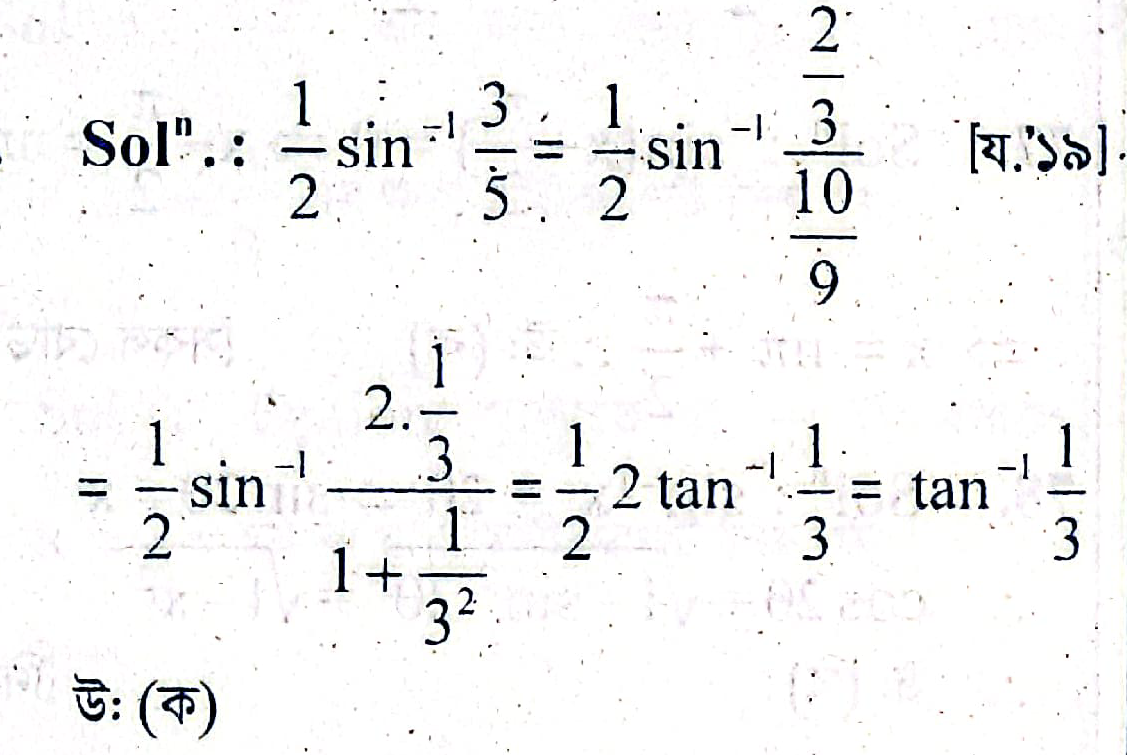
1/2 sin^-1 (3/5)=?
A.
tan^-1 (1/3)
B.
tan-1 2
C.
2 cos^-1(4/5)
D.
sin^-1(1/10)
উচ্চতর গণিত দ্বিতীয় পত্রবিপরীত ত্রিকোণমিতিক ফাংশন ও ত্রিকোনমিতিক সমীকরননির্দিষ্ট ব্যবধিতে সমীকরণ সমাধান (Topic Practice)

সঠিক উত্তরঃ
A.
tan^-1 (1/3)
Explanation:
Related Questions (Any University/Year)
- sin^-1 (4/5)+cos^-1 (2/sqrt5)এর মান নির্ণয় কর। x2 +y2 =1
- যদি x=1/2Cos^_1 (3/4) হয়, তবে tan x এর মান কত হবে? x2 +y2 =1
- দেখাও যে, sec^-1(5/4) + tan-1 (1/2)=tan^-1 2
- \( 2\sin^{-1}x = \sin^{-1}y \) সমীকরণে \( x = \frac{\sqrt{3}}{2} \) হলে, \( y \) এর মান হবে কোনটি?
- cos(sin-11/4 + cos-11/4) এর মান কত?
- Sin(tan^(–1)(1/2)+cot^(–1)3)=?
- cot^2(sin^-1(1/2)) এর মান কত ?
- cos^3 x - 1/2 * sin 2x + 1 = sin^3 x + 2 হলে x এর কতটি মান সম্ভব হবে? [যখন, π<x<2π]
- প্রমাণ কর যে, sin-1x+cos-1x= π/2
- 1+sec^2(cot^-1 2)+1+cosec^2(tan^-1 2)=?
- cos^2(sin^-1(1/(√3)))-sin^2(cos^-1(1/(√2))) এর মান নির্ণয় কর।
- sin(π/2 -cos^-1 x) = cos(cos^-1 x)=x কত?
- tan 2x tan x = 1 হলে x এর কোন মানটি সঠিক নয়?
- tan-1x+cot-1x=?
- 2 sin-1x = sin-1y সমীকরণে x = √3/2 হলে, y এর মান কত?
- g(x)=cosx;h(x)=sinxউদ্দীপকের আলোকে sqrt3g(theta)+g(π/2-theta)=1 সমীকরণটি সমাধান কর। যখন 0<θ<2π x2 +y2 =1
- cos-1 (x) - sin-1(x)=sin-1(1-x) সমীকরণটির সমাধান কোনটি?
- দৃশ্যকল্প-১: Cottheta-tantheta=6/5 দৃশ্যকল্প-২: 2Sin2theta+2(Sintheta+Costheta)+1=0 দৃশ্যকল্প-২ এ বর্ণিত সমীকরণটির সাধারণ সমাধান নির্ণয় কর। x2 +y2 =1
- \theta ধনাত্মক সূক্ষ্মকোণ হলে, 2 sin^{2}\theta=3 cos \theta সমীকরণের \theta -এর মান কত?
- sec^2(tan^-1 2)+cosec^2(cot^-1 3) এর মান কত?
- f(a)=tan^-1a, g(a)=sina সমাধান কর : g(π/2-x)+g(x)= 1/sqrt2 x2 +y2 =1
- tan-1x+2cot-1x=2π/3 হলে x এর মান কত?
- tanθ+cotθ = 2cosecθ, 0<θ<π/2 হলে θ এর মান কত?
- tan^-1(1/3)=?
- tan^-1(1/2)+tan^-1(1/3)=?
- sec^2(cot^-1. 1/4)+tan^2(cos^-1. 1/3) এর মান নির্ণয় কর। x2 +y2 =1
- sec2(tan-15) + tan2(sec-12) = ?
- cos^2( sin^-(1)(1/sqrt3)) এর মান বের কর x2 +y2 =1
- sec2(tan-13)+cosec2(tan-12) এর মান নির্ণয় কর?
- tan^-1(x+1/3)+tan^-1(x-1/3)=tan^-1 2 হলে, x এর মান-
- f(x) =cot (π/2-x) এবং g(x) =sin-1xপ্রমাণ কর যে,g(1/sqrt5)+ g(1/sqrt10)= π/4
- 2sin-1x =sin-1y সমীকরণে x= sqrt3/2 হলে, y এর মান কত?
- sinθ = x হলে sin-1x + cos-1x =?
- sintan^-1sqrt3 এর মান নিচের কোনটি ?
- f(x) = tan x এবং g(x) = sin-1 x g(y)+g(sqrt(1-y^2))এর মান নিচের কোনটি?
- sec-1 25/24 + sin-1 24/25 এর মান কত ?
- sin^2(cos^-1 (1/sqrt3)) এর মান কত?
- sec2x−2√3 tanx+2=0 হলে, (0<x<π/2)ব্যবধিতে x এর মান-
- cos^-1(1/sqrt5)-1/2sin^-1(3/5)+tan^-1(1/3)=?
- sin^-1((2a)/(1+a^2))-cos^-1((1-b^2)/(1+b^2))=2tan^-1x হলে, x এর মান কত?