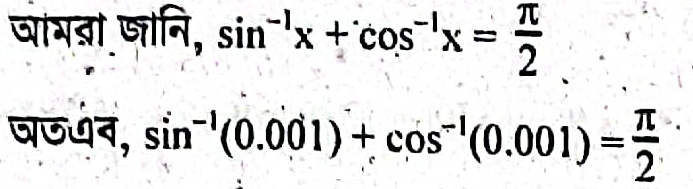
sin-1(0.001) + cos-1(0.001) কত?
A.
0.25
B.
1
C.
-pi/2
D.
pi/2
উচ্চতর গণিত দ্বিতীয় পত্রবিপরীত ত্রিকোণমিতিক ফাংশন ও ত্রিকোনমিতিক সমীকরনবিপরীত বৃত্তীয় ফাংশনের সূত্রাবলী (Topic Practice)

সঠিক উত্তরঃ
D.
pi/2
Explanation:
Related Questions (Any University/Year)
- tan^-1(3/4)+tan^-1(1/7)+tan^-1(1/2) এর মান কোনটি?
- sec-1x + cosec-1x = কত?
- Evaluate : tan^-1 (m/n) - tan^-1((m-n)/(m+n) .
- tan-1 2x + tan-13x =π/4 হলে, x =?
- 4(cot-13 + Cosec-1√5) =?
- সমাধান কর: tan (cos^-1 x) = sin (cot^-1(1/2))
- cot^(-1) (sqrt(1-x^2)/x)=?
- tan^-1(1/2)+tan^-1(1/5)+tan^-1(1/8)=?
- tan-12+tan-13+ tan-14 = 0 হলে, tanθ=?
- নিচের তথ্যগুলো লক্ষ কর—tan-11 = sin-113sin-1x = sin-1(3x-4x3)sinx এবং cosx এর যেকোনো মানের জন্য -1 ≤ sinx ≤ 1, -1 ≤ cosx ≤ 1নিচের কোনটি সঠিক?
- 1/2sin^(−1) (4/5) =?
- \( \tan (\tan^{-1} (\frac{1}{3})+\tan^{-1} (\frac{1}{2})) \) এর মান কোনটি?
- cot-1 2 - cot-1 5 এর মান কোনটি?
- sec^2(tan^-1 5)+tan^2(sec^-1 2) এর মান কত?
- 2 tan−1 (1/5) = কত?
- tan-1(2x+3) + cot-1(2x+3) এর মান কত ?
- arcsin(1/3) + cos^-1(sqrt(2/3)) =?
- সমাধান কর: sin-1 x + sin-1(1-x) = cos-1(x) |
- tan-1 + cot-1 1/3 এর মান কোনটি?
- tan^-1x + tan^-1((1-x)/(1+x))=?
- নিচের কোনটি sin(2sin-1x) এর মান?
- cos-1x + cos-1y = π/2 হলে sin-1x + sin-1y = কত?
- sin[3(sin-1x + cos-1x)]=a হলে, a এর মান কত?
- cos-1x + cos-1 y = π/2 হলে, x²+ y² এর মান বের কর।
- sin(2sin^-1(1/2))=?
- নিচের তথ্যগুলো লক্ষ্য কর-sin-1x=cosec-1 1/x sin-1x= pi/2 -cos-1xsin-1x=cos-1 sqrt(1-x^2) নিচের কোনটি সঠিক?
- tan^-1 ""2/3 +cos^-1""2/(sqrt(13))=?
- প্রমাণ কর যে, 2tan^-1{sqrt((a-b)/(a+b))tan(theta/2)}=cos^-1((b+acostheta)/(a+bcostheta))
- i)sin(πcos θ) =cos( πsin θ) ii)x=cosA,y=cosB, z=cosC A+B+C =π হলে, প্রমান কর যে x2+y2+z2+2xyz=1
- tan-11+tan-12+tan-13 = ?
- \( \tan^{-1}(\frac{x+1}{3}) + \tan^{-1}(\frac{x-1}{3}) = \tan^{-1} 2 \) হলে, \( x \) এর মান কত?
- tan^-1(1/2)+tan^-1(1/3) এর মান ???ত?
- (tan^-1 8 + tan^-1 "9/7)এর মান কত?
- tan-1 1 + tan-1 2 + tan-1 3 = ?
- sin-1(1/3) + cos-1√(2/3)=?
- sin^(-1) (4/3) + cos^-1(2/sqrt5) এর মান নির্ণয় কর।
- tan^-1((2x)/(1-x^2))=sin^-1((2a)/(1+a^2))+cos^-1((1-b^2)/(1+b^2)) সমীকরণে x এর মান হল-